ABOUT
I’m not the shaman.
That’s kind of the point.
I’ve spent a lot of my life around people and institutions that were supposed to have answers.
The military had answers. Mental health had answers. Medicine had answers. Religion had answers. The psychedelic and plant medicine world definitely has people who believe they have answers.
Some of those answers saved my life.
Some nearly destroyed it.
And somewhere along the way, I stopped looking for someone else to tell me what was true.
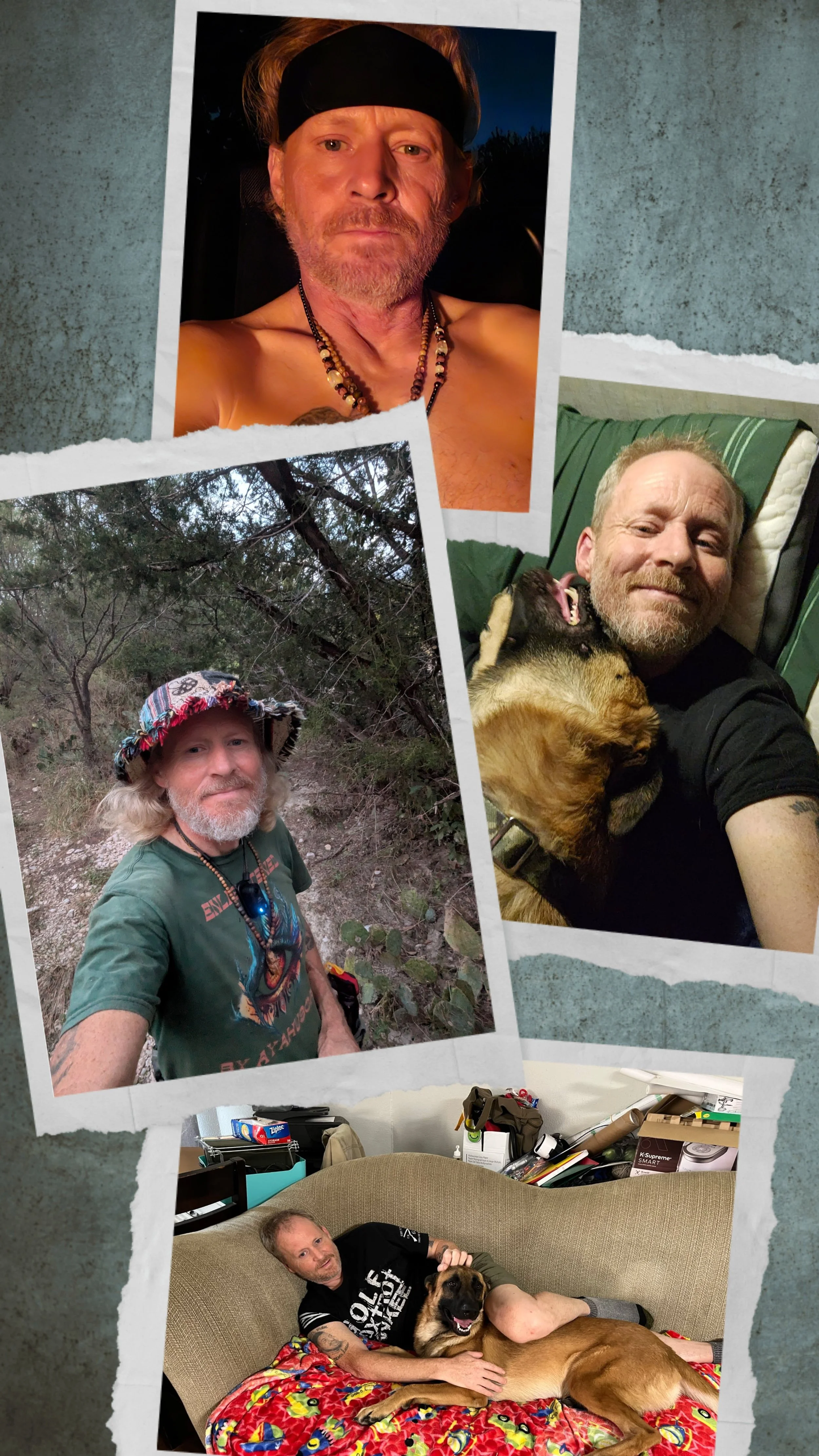
My name is Bob Stead.
I’ve been a runaway, a street kid, a soldier, a combat medic, a patient, a trauma therapist, a husband, a father, an author, a protester, a psychedelic explorer, and probably a few things I’ve forgotten.
I served as a combat medic with the 3rd Infantry Division during the 2003 invasion of Iraq and came home on a stretcher.
Years later, I earned a master’s degree in Clinical Mental Health Counseling and spent nearly a decade working in trauma care, including ketamine-assisted psychotherapy and psychedelic-related work.
Eventually, I found myself on the other side of the equation.
I had spent years helping other people survive their trauma while becoming increasingly disconnected from my own life. Plant medicine became part of finding my way back. It changed my life profoundly.
And it also introduced me to another world full of wounded people pretending they had all the answers.
That taught me something important.
The teacher should eventually become unnecessary.
I don’t want followers.
I don’t want people to replace one authority with another and call it awakening.
I’m increasingly suspicious of any teacher, therapist, healer, institution, ideology, or spiritual system that leaves people more dependent on it than when they arrived.
A question I’ve learned to ask is:
After interacting with this teacher, do I need the teacher more, or do I need the teacher less?
The same question applies to me.
If something I write or create helps you see something differently, use it. If it doesn’t, leave it here. If you discover that I’m wrong, I hope you’ll tell me.
And if five years from now I still believe everything I believe today, I probably haven’t been paying attention.
So why “Not the Shaman”?
Because I don’t want the fucking job.
I’m not interested in becoming someone’s guru, spiritual authority, or keeper of secret knowledge.
I’ve learned some things. I’ve survived some things. I’ve studied some things. I’ve been spectacularly wrong about some things.
And I’m willing to talk about all of it.
Not the Shaman is my reminder, and hopefully yours, that nobody gets to outsource the responsibility of figuring out what they believe.
Not to a therapist.
Not to a government.
Not to a church.
Not to a medicine.
Not to a teacher.
And certainly not to me.
Why this website exists
This website is where all of those threads come together.
Veterans. Trauma. Mental health. Plant medicine. Spirituality. Institutions. Relationships. Parenting. Healing. Writing. Self-reliance. The stories we're handed and the stories we tell ourselves.
Some of what you'll find here comes from research. Some comes from professional experience. Some comes from lived experience. Some is interpretation. Some is belief. And sometimes I'm simply thinking out loud.
Those distinctions matter.
The goal isn't to convince you to see the world the way I do.
It's to encourage both of us to keep looking.
See clearly.
Think freely.
Live deliberately.
Serve something beyond yourself.
Yes, I Use AI.
I use artificial intelligence, and I'm not the least bit embarrassed about it.
I use it to research, organize ideas, challenge my assumptions, examine opposing arguments, and turn decades of lived and professional experience into resources that other people can actually use.
What I don't do is ask AI to manufacture wisdom about things I don't understand and then present the results as my own expertise.
My experiences are mine. My convictions are mine. My mistakes are mine. And the responsibility for what I publish is mine.
AI is a tool. It doesn't replace my judgment, my experience, or my responsibility to question what I'm being told. In fact, I expect it to challenge me when my reasoning doesn't hold up.
I use AI because I have more ideas, more experience, and more work I want to accomplish than I have hours in the day.
I'm not using AI to manufacture authenticity. I'm using it to maximize my impact.
And if that helps me reach one more veteran who needs a reason to stay alive, I'll use every responsible tool available to me.